
 Tattooing is one of the oldest rituals in Berber culture, whose origins date back to the pre-Islamic period. These Berber ethnic groups, of which we find traces dating from Pharaonic antiquity, nomadic tribes and Berber-speaking groups, historically have a presence in more than ten African countries, from the Mediterranean Maghreb to sub-Saharan Africa. passing through Egypt and Niger, from the Atlantic Ocean to the shores of the Nile.
The Berber tattoo is linked to an outfit of pagan customs of witchcraft and magic. These beliefs are still the subject of customs in the countryside, where Islam has only partially integrated these ancient practices and beliefs. The tattoo called “el-âyacha” (“the one who brings life”), is sometimes practiced in country circles, where women have always protected their children from bad luck and bad luck by drawing on their foreheads with standard lampblack example. We find this custom when the day of the birth of a child coincides with a harmful event. The tattoo here has a function of correspondence between the human body and the spirit world. Today, in the Maghreb, the henna tattoo is part of the Berber customs, the ornamental side having long since taken over the primitive magic meaning.
From time to time, the tattoo has been a custom among Berber women, whether for ornamental purposes, to adorn themselves as with jewelry and to make themselves more beautiful and desirable, with a subtle well-play of eroticism in idea , or to express an opinion, to symbolize a social status (death of the husband and widowhood for example, the Berber woman can watch a tattoo on the chin depending on each ear, symbolizing the beard of the dead husband). Dating back to the Neolithic period in North Africa, the tattoo of nomadic Berber tribes was also used to dissociate and identify the members of the different Amazigh tribes through drawings, often on the appearance, with very geometric characteristics and supposedly magical virtues: the tattoo was in particular believed to seer bad luck (ward off the evil eye) and bring good fortune and success. Today taken up again, women are the guardians of the customs of a very ancient civilization, which goes against current Islam, as it is interpreted in many countries. The tattoo partially adapted to this Koranic ban, in particular by never representing the image of the man.
 For Muslims, most of the time, the tattoo is proscribed by Islam, symbol of sin and mutilation, adjustment of the divine work, despite its status of immemorial custom, the imams continuing to condemn ancient beliefs in supernatural elements. This is why women, the main users of aesthetic designs on the skin, today use more commonly, for religious reasons, the temporary and non-mutilating henna tattoo. There are many ceremonies associated with Henna, during which it remains very present, even today: the custom of marriage (ritual of the “night of henna”, birth, baptism, circumcision.
The Imazighen, (free men) or Berbers, tattooed their forehead, chin, cheeks, back of the hands and temples using shades from substances of vegetable origin, charcoal, mixed with water or blood, themes and symbols that were specific to them and had a very particular meaning. The tattoo then was more social than ornamental, unlike today, where this idea of symbolic tattooing has disappeared in the new generations of Berbers, even if it can sometimes retain an idea of attachment to a community, allowing the Berbers and in particular the Kabyles to stand out culturally from the Arabs.
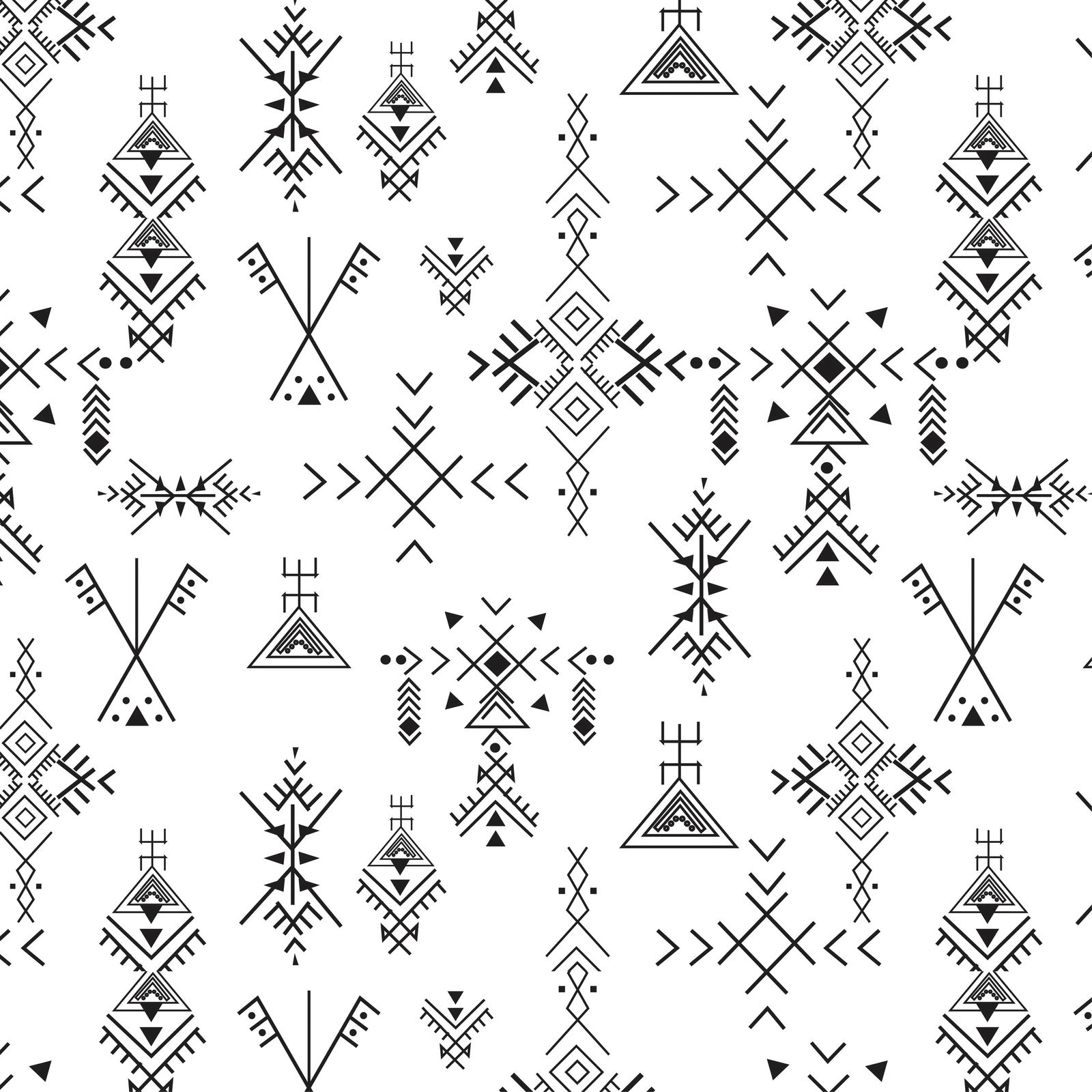 Each detail, each theme has its own symbolism in the Berber tattoo
-The dot represents the hall, which is in focus of the house
-The crescent moon matter that is born, grows and dies.
-The spiral represents eternal harmony
-The circle represents the absolute.
-The tattooed palm trees on the forehead of Berber women invoke the mother goddess
-The vertical chief attribute represents god and life, as well as the head tool planted in the ground by man
-The two attributes symbolize the duality between good and evil that lies dormant in everyone.
-The square is the representation of the house
-Two superimposed squares symbolize the battle of god against the curse and the darkness
-The rosette, composed of triangles: the one with the point up represents fire and virility, while the triangle with the point down represents water and femininity
-The plus to (sign +) represents the eye of God, the star whose light guides man in the night
-The cross represents the two legs or the two arms of man.
Other symbols: the palm of the palm, the rafters, the pectin of fir trees, the lines of life
In the Berber culture, there are several functions for the tattoo:
-Aesthetic function: The tattoo is often done in an aesthetic way, which gives women the virtue of beauty. Therefore, the woman places it in different parts of her body, especially the appearance and exactly where it is engraved in the chin, forehead, nose and cheeks. The however is to attract and impress others, like the textual style of many Berber tribes. In other words, tattoos are a kind of makeup that is generally used by women for beauty, arousing admiration, the body becomes a painting canvas with its bright and shiny shapes, lines and colors or a text where the tattoo becomes a speech. This means that the tattoo was the true indication of the beauty of Berber women but also a faithful articulation of her beauty, which impressed others with interest and lust.
-Function of purity: The tattoo is associated with the function of purity: as it purifies the human soul from evils and sins, and purifies them from impurities, sins by arousing fear, empathy, repentance and the desire to seek forgiveness … That is to desperate: The tattoo in the sense of scratching and penetrating the skin in the desire to purify, according to a group of rules of rituals and rules of ceremony. Additionally, tattoos are penances and fidelity, loyalty, sincerity, redemption for spiritual fulfillment. Thus, obtaining holiness of soul and attaining perfect transcendence. what it means to cleanse with the intention of attaining spiritual purity thus The tattoo also expresses an intermediate bridge between matter and spirit, between body and sanctuary.
-Therapeutic function: for the Berbers Tattoos have a therapeutic function, since they protect the human being against organic and psychological ailments and protect them from the dangers of acute epidemics and nature. For example, women used tattoos on the overthrow to protect themselves from goiter disease, tattoos on the ankles, Achilles ligament and shoulders protect against sterility, those on the wrists protect against sprains and above the chest. brow bone, they relieve eye pain. In some tribes, tattoos are generally limited to a single point above the chin, one on the right side of the nose to protect against scratches.
-Magical function: Magical function is the most important function of tattoos, as in many primitive, African and Amazigh peoples, where tattoos turn into a magical tool to counter mysterious and hidden powers, promotes immunity against metaphysical evils. They are associated with a magical function as they protect children from the evil eye, protect the community from potential enemies and protect them from evil spirits, such as tattooing as a symbiotic association between body and spirits. Thus, tattoos have become geometric shapes and magic signs that protect man from the evil of nature, protect him from envy and keep him away from poverty, calamities and bad fate. The tattoo was also a symbol of success and survival, but also a means of earning money.
-Identity function: The tattoo is an identity phenomenon that expresses the cultural and civilizational characteristics of Amazigh man and infers his ancient presence on the lands of Tamazgha11 through his rituals and customs. In this sense, tattooing is an anthropological phenomenon known to Amazigh man since the dawn of time and practiced daily. Besides, tattoos are symbols that expresses identity, sexuality, ethnicity and culture of human being, and distinctly distinguishes people of the world. The tattoos also express a progress from childhood to adulthood, belonging to the community or tribe. In addition, the tattoo has a totemic and ritual function associated with tribal life and is closely linked to its behavior patterns and tribal values. Totems is one of its facets. They are the best way to show the symbolism of emblems. Often people draw symbols on their bodies or tattoo them to confirm their affiliations to a particular tribe or community, and here the tattoo comes across as a form of self-distinguishing proof.